St. Louis City Needs Tax District Reform

Man with giant green money bag

I am posting the written testimony submitted by Gerry Connolly to St. Louis City Board of Alders Housing and Urban Development Committee on Board Bill 19 to create two single-site tax districts for luxury living Jefferson Arms, a Community Improvement District and Transportation Development District.

Gerry is right about both the Board make up of these tax districts and the need for tax district reforms, which former Missouri State Auditor Nicole Galloway also recommended in 2019.

In the 2024-25 Board of Alders session, a special committee was created to look into special tax districts, but nothing came of it. The committee was not even renewed for the 2025-26 session.

If you’re on Bluesky, search #TransparencyFail. Most of the posts are about St. Louis City Special Tax Districts (or Local Tax Districts (LTDs) if you’d prefer not to use STDs).

Also check out the ProPublica series: “Policing in St. Louis. Private Policing Firms Patrol Wealthy Neighborhoods” about neighborhood tax districts.

Gerry’s testimony

“Please consider this recommendation to amend Board Bill 19 as follows: change the composition of the boards to ensure that representatives of the developer of property in the Jefferson Arms CID/TDD do not constitute a majority of the board. Officials representing City of St. Louis government should make up a majority of seats on the board. 

BB 19 specifies the CID shall have five board members, the City of St. Louis should therefore have three representatives on the board. 

I have included below an except from my written testimony on the FY 2026 Budget/Operating Plan which outlines eight recommendations to reform the Local Taxing Districts in the City of St.Louis.

  • Budget testimony item 7: Eight reforms for the BOA to enact for Local Taxing Districts (LTDs) It is possible that changes to Missouri law will be necessary in order to accomplish some of the recommendations. The budgets of the 100 plus LTDs in the City likely exceed $50 Million, with taxes and/or special assessments imposed on the public. The vast majority of LTDs operate routinely in violation of Missouri Sunshine law.
  1. Enact all recommendations of the 2019 Missouri Auditor’s report on LTDs. The audit report is available online (See pages 9 – 18 for recommendations)
  2. Place all policing duties funded by LTDs under the command of SLMPD.
  3. Extend community oversight of surveillance technology to all LTDs.
  4. A representative of the following must be appointed to the board of all single-site LTDs: Mayor, Board of Aldermen and Comptroller.
  5. Prohibit developers from controlling single-site districts.
  6. Document all City of St. Louis resources allocated to the LTDs. Such resources include: (i) City funds expended on projects of the LTDs. (ii) city staff attending LTD meetings. (iii) work performed by city staff to support the activities of LTDs. (Examples of city staff: SLMPD personnel when working for the City; Neighborhood Improvement Specialists).
  7. Establish robust Conflicts of Interest regulations for people serving on the boards and committees of LTDs.
  8. Establish a limit on the number of LTD boards on which one person can serve. (Some individuals serve on at least five LTD boards)”

Will STL E&A, Tax Districts Go To AG Sunshine School?

Art: Sun wearing sunglasses

Pleased to share that there has been a Transparency Win regarding St. Louis City’s Board of Estimate & Apportionment. On June 24th, E&A began publishing Exhibits with Agendas on City’s website.
——————–

An interesting development in enforcement of Missouri’s Sunshine Law happened last week in a city of 6,344 in southwest Missouri. It could impact government entities in St. Louis City, including the powerful Board of Estimate and Apportionment (E&A: Mayor, Comptroller, Board of Alders President).

The City of Willard has ben slapped on the wrist by the Missouri Attorney General’s Office and told they have to attend Sunshine School. At issue was the use of the generic Agenda topic “Unfinished Business” by Willard’s Board of Aldermen. (paywall) The AG’s Office says it should also include sub-topics detailing points of discussion.

That’s potentially huge because many St. Louis City special tax districts, agencies, and even the Board of E&A routinely use generic categories for Agendas.

As examples, Soulard Special Business District, a taxing district to fund private police and surveillance, and Soulard Community Improvement District, a taxing district to fund improvements with $1.8 Million dollars banked, both use skeleton agendas. They also have an atrocious record of posting late notices or wrong meeting location to the City’s online public meetings calendar.

The significance of E&A failing to provide specifics in their Agendas was highlighted recently when E&A approved more funding for the controversial ShotSpotter contract without public notice.

ShotSpotter is a surveillance product by SoundThinking. While cities have been turning down contract renewals and Chicago may soon dump the program, as promised by its mayor, St. Louis City’s E&A gave the contract a fourth amendment. And it was done, as is most E&A business, without the public notice.

For twenty years, it has been standard practice of E&A to post meeting notices and agendas to the City’s Public Meetings Calendar. The Agenda for the December 20, 2023 E&A Meeting, like most meetings, included:

“Request from the Comptroller’s Office for approval of contracts and leases for various
City departments as listed on Exhibit A.”

“Request from the Comptroller’s Office for approval of intradepartmental and
interdepartmental transfers from various City departments as listed on Exhibit B.”

“Request from the Comptroller’s Office for approval of transfers between projects for
Capital Improvement Funds listed on Exhibit C.”

But no Exhibits, the meat and potatoes of what they’re voting on, is available online for public inspection.

In the case of the December 20 Agenda, ShotSpotter was in Exhibit A, Item 17, hidden from the public. There was no opportunity for the public to contact E&A with concerns.

Item 17, Exhibit A, St. Louis Board of Estimate and Apportionment Agenda, December 20, 2023: ShotSpotter amendment

There was no debate on the ShotSpotter amendment. It was adopted on a 2-1 vote. Mayor Tishaura Jones and Comptroller Darlene Green voted yes; Board President Megan Green voted no.

No E&A Exhibits to Agendas or Meeting Minutes are posted online. How do we know the amendment happened and that the vote was? E&A meetings, usually very short, can be watched via Zoom or City’s YouTube channel.

Screenshot of Tweet by St. Louis Board of Alders President Megan Green regarding her vote against Shotspotter contract amendment

We can see from the YouTube video that Board President Green made a motion to separate ShotSpotter from the rest of the Agenda for the vote. She gave no reason why at the meeting. But, as the meeting ended, 7 minutes after starting, Green Tweeted about her vote against ShotSpotter. A graphic had been prepared in advance.

Why didn’t Green share the ShotSpotter Exhibit item with the public, Privacy Watch STL coalition, etc. before the meeting? That’s a good question.

The next meeting of E&A is 3 pm Wednesday, January 17th. Exhibits A, B, C missing. Again. The secret business is anyone’s guess.

People also Sunshine E&A Exhibits.

“Sunshine Gerry” Connolly usually makes a request as soon as the E&A Agenda is posted online. It can take a day to a month for the documents to show up in the City’s Sunshine Portal.

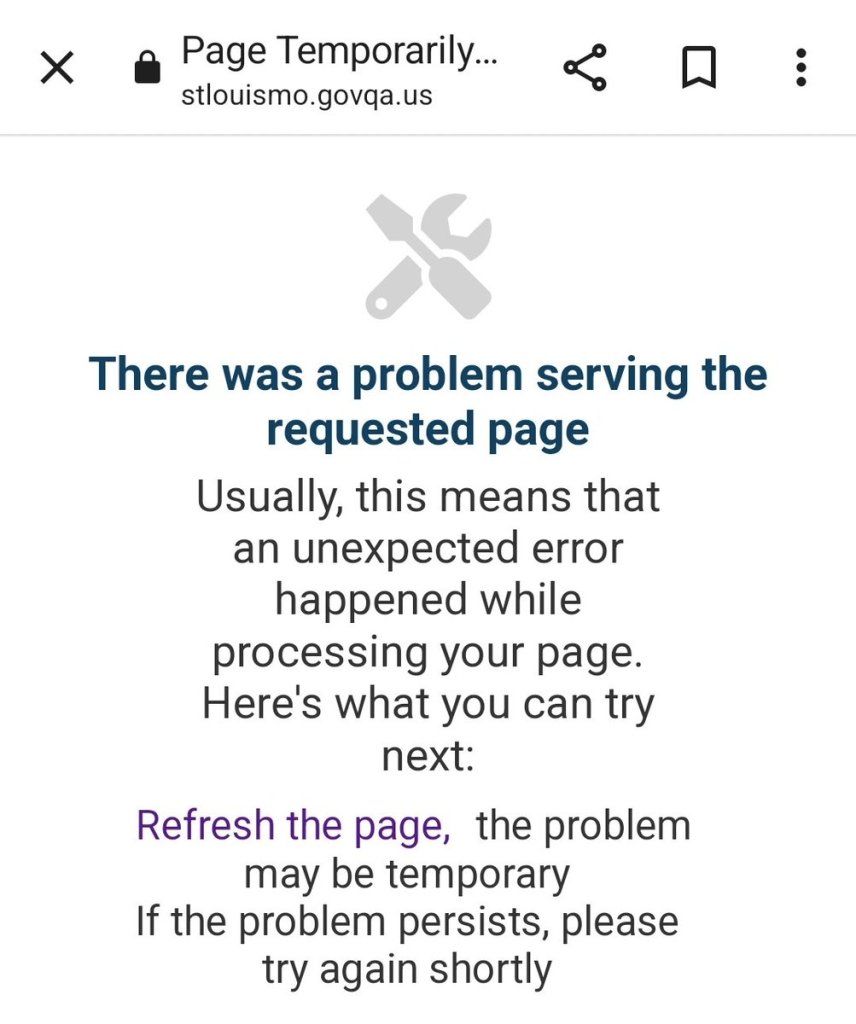
Screenshot of error message from St. Louis City Sunshine Portal, Public Records Archives

Public access to the Portal’s Public Records Archives is limited to when it is functioning, which is often not the case. It’s been down most of today while I’ve been trying to write this. You have to be persistent when filing a Sunshine request. Try in the morning. Try again in the afternoon. Lather. Rinse. Repeat.

Big question is why aren’t E&A Exhibits posted with the Agendas? Why the secrecy?

Maybe it’s time for the AG to look at how government entities in St. Louis City comply (or don’t) with Missouri’s Sunshine Law.

It’s definitely time for St. Louis City to have a strong municipal Sunshine Law in the Charter (via amendment by Charter Commission or otherwise) or via ordinance by Board of Alders.

Who will lobby for less transparency now?

Special Tax District lobbyist Bill Kuehling terminated his lobbyist registration at Missouri Ethics Commission last month. Kuehling was first hired by St. Louis City’s Senior Citizens’ Services Fund Board while working at Thompson Coburn. He helped create the Senior Fund’s special property tax.

After he left the firm, the Senior Fund Board hired him to lobby the Missouri General Assembly to eliminate the statutory requirement that the Fund’s budget be approved by the Board of Alders.

Kuehling was successful in 2021 with an amendment added to House Bill 271 to remove oversight of the City’s Senior Fund. Senior Funds in all other counties must be approved by their county council or county commission.

The Senior Fund Board later honored State Rep. Donna Baringer and accused rapist State Senator Steve Roberts for handling the change.

Tax districts in St. Louis City- such as Senior Fund and Metropolitan Parks & Recreation (dba Great Rivers Greenway)- go on the ballot with promises to voters that Board of Alders have oversight over their budgets. Then they hire lobbyists to work with legislators to change state laws they are governed by, make them independent of local government.

Maybe Alex Kuehling at Rosenblum Goldenhersh will follow in his father’s footsteps and become a lobbyist as well as corporate welfare attorney.

Alex wrote the Fiscal Note for Board Bill 165 to create special tax districts for the hot mess known as Jefferson Arms. The sales and uses taxes created by Jefferson Arms Community Improvement District and the Jefferson Arms Transportation Development District are pledged to the redevelopment’s TIF.

Why are developers via their agents allowed to prepare the Fiscal Notes for their corporate welfare? A government office prepares the Fiscal Notes for legislation everywhere else.

For State legislation, the Missouri General Assembly’s Oversight Division prepares Fiscal Notes.

But Ordinance 70404 (Board Bill 63 sponsored by Alder Antonio French et al) requiring Fiscal Notes by the Board of Alders was poorly written or intentionally vague. Unlike the State’s Fiscal Note law, the City’s law does not specifically say who can shall and shall not write the document. Foxes are left to guard the henhouse.